
Are You Choosing the Right Granulator Blade? A Guide to Types and Materials
Are You Choosing the Right Granulator Blade? A Guide to Types and Materials
Table of Contents
- Understanding Blade Types: Rotor vs. Stator & Beyond
- Material Mastery: From D2 Tool Steel to Solid Carbide
- Your Granulator Blade Selection Checklist
- Proactive Strategies for Maximizing Blade Life
- The ShengAo Partnership: Precision, Performance, & Value
1. Understanding Blade Types: Rotor vs. Stator & Beyond
Granulators operate on a simple yet precise cutting principle involving two primary blade types. Knowing their distinct functions is the first step toward optimal machine performance.
Rotor Blades (Rotating Blades): These are the movable blades mounted on the central rotating shaft. They provide the primary cutting force, spinning at high speeds to shear material against the stationary blades. Their design—including hook angle, length, and thickness—is tailored to the material's characteristics (e.g., brittle plastic vs. tough film). Proper rotor blade selection dictates cutting efficiency and granule size. Explore our comprehensive range of crusher and granulator blades.
Stator Blades (Fixed or Bed Blades): These blades are securely fixed in the granulator's housing or "bed." They do not move. Their critical role is to provide a counter-cutting edge against which the rotor blades shear the material. The precise gap between rotor and stator blades is adjustable and crucial for determining the final particle size and cutting cleanliness.
Specialized Blade Designs: Beyond the basic straight blade, various designs address specific challenges:
- Scissor-Cut or Hooked Blades: Feature an angled hook to grip and cleanly slice through flexible materials like film and fibers, preventing wrapping.
- Staggered Rotor Configurations: Use blades arranged in a helical or staggered pattern for smoother operation, reduced vibration, and better feeding of bulky items.
Choosing the right type isn't optional; it's fundamental. A film granulation blade will struggle with rigid purgings, just as a straight blade may cause tangling with soft materials. For specialized needs, our industrial blade guide offers deeper insights.
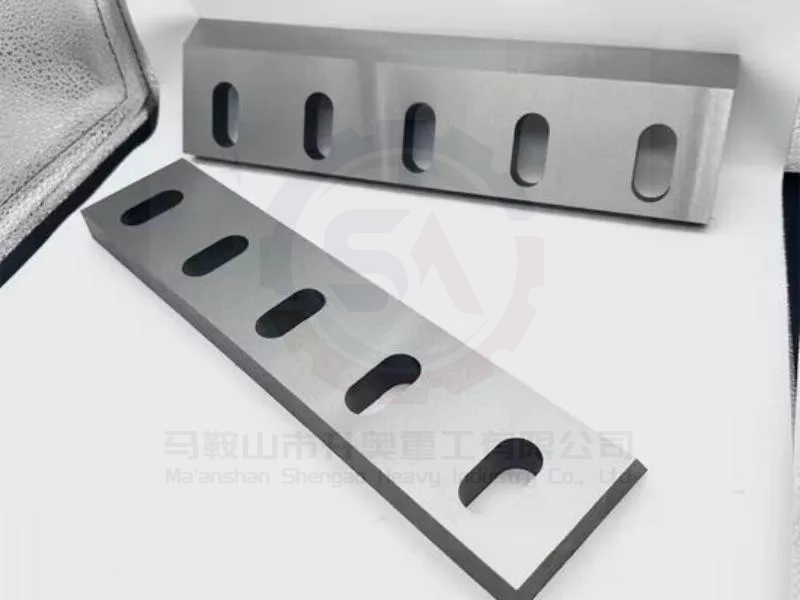
2. Material Mastery: From D2 Tool Steel to Solid Carbide
The blade's core material is the ultimate determinant of its service life, edge retention, and cost-effectiveness. Selecting based solely on price is a shortcut to higher total cost of ownership (TCO). Here’s a breakdown of the most common and advanced materials.
| Material Grade | Key Properties & Typical Hardness | Ideal Application Scenario | Value & Durability Insight |
|---|---|---|---|
| D2 / AISI D2 Tool Steel | High-carbon, high-chromium steel offering excellent wear resistance and good toughness. Hardness: HRC 58-62. Holds an edge well and can be resharpened multiple times. | The industry standard for most plastic granulation (PP, PE, ABS, PS). Perfect for engineering plastics, purgings, and pipes. Offers the best balance of performance and cost for general use. | Superior to basic carbon steels, providing 3-5x longer life. Excellent value through multiple sharpening cycles. Discover ShengAo's premium D2 tool steel blades. |
| High-Speed Steel (HSS - M2, M42) | Exceptional hot hardness, meaning it retains its cutting edge at elevated temperatures generated during high-volume processing. High abrasion resistance. | Continuous, high-throughput operations, abrasive materials, or applications where heat buildup degrades standard tool steel edges. | A high-performance upgrade for demanding conditions. Learn about the benefits of HSS cutting blades for your operation. |
| Tungsten Carbide Tipped (TCT) | Carbide tips (extreme hardness, HRA 90+) are strategically brazed onto a tough steel body. Combines a wear-proof cutting edge with impact-resistant support. | Highly abrasive or filled materials (fiberglass, minerals, carbon fiber), mixed waste streams, or where superior edge life is needed without the full cost of solid carbide. | The smart hybrid choice. Delivers up to 8x the life of tool steel on the cutting edge while managing cost and resisting chipping. See our alloy-tipped solutions. |
| Solid Tungsten Carbide | The pinnacle of wear resistance and hardness (HRA 92+). Unmatched longevity but more brittle, requiring perfect machine alignment and no contaminants. | The most challenging applications: continuous processing of ultra-abrasive composites, high-purity food/pharma regrind, or situations where blade changeover downtime is extremely costly. | Highest initial investment, but lowest cost-per-hour in justified applications. Maximizes uptime and consistency. Explore tungsten carbide blade options. |
3. Your Granulator Blade Selection Checklist
Armed with knowledge of types and materials, use this practical checklist to specify your next set of blades correctly.
1. Material to be Processed: Is it clean PP film, glass-filled nylon, PVC pipes, or mixed post-consumer waste? Abrasiveness, toughness, and flexibility dictate material and blade design.
2. Machine Make & Model: This is non-negotiable. Blades are engineered for specific granulators (e.g., Vecoplan, Rapid, Foremost, NGR). Provide the exact model and serial number to ensure perfect dimensional fit. Our OEM replacement service guarantees compatibility.
3. Desired Output Size: The gap between rotor and stator blades directly controls granule size. Ensure your blades and machine setup can achieve your target particle distribution.
4. Production Volume & Duty Cycle: Is it a 24/7 operation or batch processing? High-volume runs justify investment in premium materials like HSS or carbide for lower long-term TCO.
5. Total Cost of Ownership (TCO) Analysis: Calculate cost per kg processed, not just blade price. A 50% more expensive blade that lasts 300% longer reduces downtime, labor, and your overall cost.
4. Proactive Strategies for Maximizing Blade Life
Even the best blades require proper care. Implement these practices to protect your investment and maintain peak performance.
Establish a Sharpening Schedule: Don't wait for blades to become completely dull. Schedule regular, professional resharpening to restore the precise cutting geometry. This prevents excessive wear on the machine and maintains consistent particle quality. Check our video hub for maintenance guides.
Precision Installation & Torquing: Always use a calibrated torque wrench. Incorrect or uneven bolt torque is a leading cause of premature blade failure, uneven wear, and catastrophic rotor damage.
Regular Cleaning & Inspection: Prevent material buildup on blades and rotors. Periodically inspect blades for nicks, uniform wear patterns, and signs of corrosion. Clean machines between different material runs to prevent contamination.
Monitor Machine Health: Listen for changes in sound and monitor motor amperage. Increased vibration or power draw often signals blade wear or other mechanical issues before they cause major damage.
Proper Storage: Store spare blades in a dry, clean environment and apply a light coat of anti-corrosive oil to prevent rust.
5. The ShengAo Partnership: Precision, Performance, & Value
Choosing the right granulator blade is a technical decision that benefits from expert partnership. At ShengAo, we go beyond supplying blades; we deliver engineered cutting solutions.
Application Engineering Support: Our technical team analyzes your material, machine data, and goals to recommend the optimal blade type and material. We solve unique challenges with fully custom blade designs.
Guaranteed Quality & Consistency: Every ShengAo blade is manufactured with certified materials, precision CNC grinding, and controlled heat treatment to achieve specified hardness (like HRC 58-62). This ensures predictable performance and lifespan batch after batch.
End-to-End Support: From initial consultation and technical help to sharpening services and lifecycle management, we partner with you for long-term success.
Global Reliability: As a trusted industrial blades manufacturer, we supply durable, high-performance blades that meet the stringent demands of recycling, plastics, and packaging industries worldwide.
Conclusion
The question isn't just "Are you choosing the right granulator blade?" but "Are you optimizing your entire cutting process for maximum profitability?" By systematically understanding blade types, selecting the advanced material that matches your application, and implementing disciplined maintenance, you transform a routine consumable into a strategic asset. The result is tangible: reduced downtime, lower energy consumption, consistent high-quality output, and a significantly lower total operational cost.
Partner with a manufacturer that brings engineering expertise to the table. Let ShengAo help you make the choice that boosts your efficiency and protects your bottom line.
Ready to optimize your granulation process? Contact the ShengAo engineering team today for a personalized blade recommendation and TCO analysis.