
What is the Best Material for Plastic Granulator Blades
What is the Best Material for Plastic Granulator Blades
Table of Contents
What is the Best Material for Plastic Granulator Blades?
Discover the best materials for plastic granulator blades. Our guide compares D2, SKD-11, carbide-tipped blades and more for optimal efficiency, reduced downtime, and cost savings.
Selecting the optimal material for your plastic granulator blades is a critical decision that directly impacts your operation's productivity, maintenance costs, and final granulate quality. With plastics ranging from soft films to rigid engineering polymers, no single blade material fits all applications. This comprehensive guide cuts through the confusion, comparing top-performing materials like D2 tool steel, SKD-11, and carbide-tipped options. You'll gain clear insights to make an informed choice that maximizes blade life, ensures consistent particle size, and delivers significant cost savings through reduced downtime and longer service intervals.
Understanding Plastic Granulator Blade Requirements
Before evaluating specific materials, it's essential to understand the unique demands placed on plastic granulator blades. Unlike general shredding, granulation requires precision cutting to create uniform pellets or flakes, placing a premium on specific blade properties.
Key Qualities of an Effective Plastic Granulator Blade:
- Superior Wear Resistance: Plastics, especially filled or reinforced varieties (e.g., glass-filled nylon, PET), are highly abrasive. Blades must resist constant wear to maintain precise dimensions and cutting geometry.
- High Hardness with Good Toughness: Blades need a hard edge (typically HRC 58-62) for sharpness and longevity, but sufficient toughness to resist chipping from occasional hard contaminants or inconsistent feed.
- Excellent Corrosion & Chemical Resistance: Many plastics release acidic by-products or additives when processed. Blades must resist rust and chemical attack to preserve their edge integrity.
- Precision Edge Retention: Consistent granulate size depends on a stable cutting edge. The material must hold its sharpness over long periods to prevent uneven cuts, fines generation, and energy waste.
- Thermal Stability: Friction generates significant heat. The blade material must retain its hardness and resist thermal softening during continuous operation.
Different Materials for Plastic Granulator Blades
The market offers several high-performance steels and composites, each with distinct advantages for plastic granulation.
1. D2 Tool Steel
A high-carbon, high-chromium cold work tool steel, D2 is a benchmark material for many industrial crusher blades. It offers an excellent balance for general-purpose plastic granulation.
Pros:
- High wear resistance due to its significant chromium carbide content.
- Good hardness (up to HRC 62) after heat treatment.
- Better toughness than many other high-hardness tool steels, reducing chipping risk.
- Cost-effective for a wide range of standard plastics (PP, PE, ABS, PS).
Cons:
- Moderate corrosion resistance; not ideal for wet or highly acidic plastic streams.
- Can be outperformed by more specialized materials on highly abrasive or reinforced plastics.
Best for: General-purpose granulation of common thermoplastics, offering a reliable balance of performance and value.
2. SKD-11 (JIS Standard) / AISI D2 Equivalent
SKD-11 is the Japanese JIS standard counterpart to D2, often manufactured to exceptionally high purity and consistency standards. At ShengAo, our SKD-11 blades undergo precise heat treatment for optimal performance.
Pros:
- Consistent microstructure and uniformity, leading to predictable wear patterns.
- Exceptional wear resistance and edge retention, often surpassing standard D2 due to tighter quality control.
- Ideal for high-volume, continuous operations requiring minimal blade adjustment.
Cons:
- Higher cost than standard D2, justified by longer life and consistency in demanding settings.
Best for: High-precision granulation, engineering plastics, and operations where maximizing time between sharpening is critical.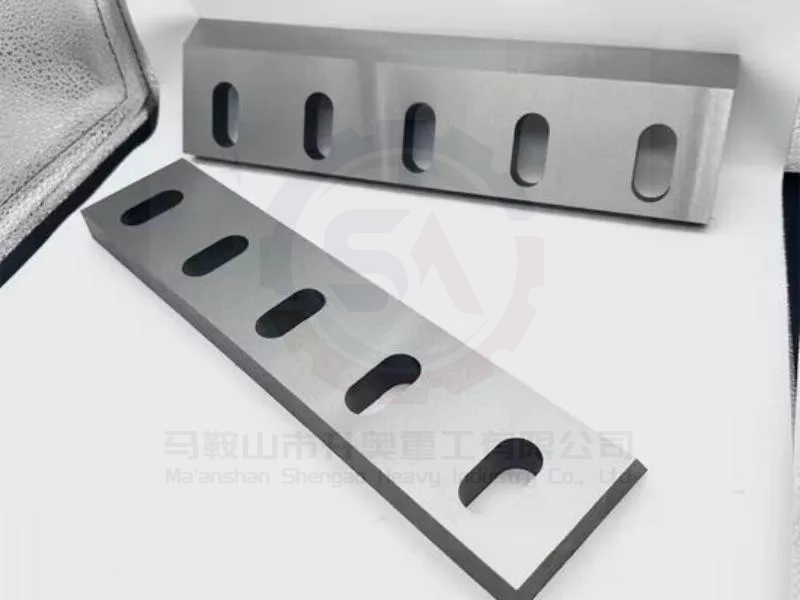
3. Carbide-Tipped Blades
These blades feature a body made of tough alloy steel (like 42CrMo) with tungsten carbide inserts brazed onto the cutting edges. This combines the best of both worlds.
Pros:
- Extreme wear resistance at the cutting edge, outlasting tool steel by 5-8 times on abrasive materials.
- The steel body absorbs vibration and impact, providing durability.
- Excellent for glass-filled, mineral-filled, or fiber-reinforced plastics. Explore our alloy-tipped blade solutions.
Cons:
- Higher initial investment.
- Brazed tips can detach under extreme impact or thermal cycling if not manufactured correctly.
- Requires diamond grinding for sharpening.
Best for: Highly abrasive plastics, composite materials, and applications where ultimate blade life is the primary goal.
4. Solid Tungsten Carbide (Solid Carbide)
The pinnacle of wear resistance, solid carbide blades are used for the most challenging granulation tasks.
Pros:
- Unmatched hardness and wear resistance.
- Superior corrosion resistance.
- Maintains a razor-sharp edge for extremely clean cuts on brittle plastics.
Cons:
- Very high cost and inherent brittleness; susceptible to catastrophic failure from impact.
- Limited to specific, high-value applications due to economics.
Best for: Specialty applications like high-purity medical or optical plastic regrind, or ultra-abrasive materials where no other solution lasts.
5. Powder Metallurgy High-Speed Steels (PM-HSS) like M2, M4
These steels offer a fine, uniform distribution of carbides, enhancing their properties over conventional HSS.
Pros:
- Excellent combination of hardness, wear resistance, and toughness.
- Good red-hardness (thermal softening resistance), beneficial in high-friction granulation.
Cons:
- More expensive than standard tool steels like D2.
- Corrosion resistance is not a primary feature.
Best for: Processing tough, stringy plastics (e.g., certain nylons, films) where a combination of sharpness and durability is needed.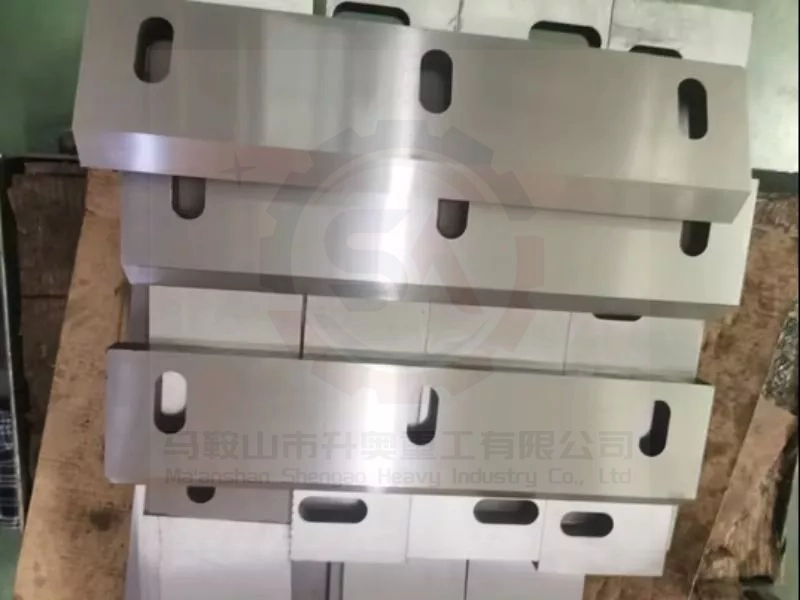
Material Comparison Table
| Material | Typical Hardness (HRC) | Wear Resistance | Toughness | Corrosion Resistance | Relative Cost | Best Plastic Type |
|---|---|---|---|---|---|---|
| D2 Tool Steel | 58-62 | High | Good | Moderate | $$ | PP, PE, ABS, PS (General Purpose) |
| SKD-11 | 60-62 | Very High | Good | Moderate | $$$ | Engineering Plastics, High-Volume Runs |
| Carbide-Tipped | 70+ (Tip) | Exceptional | Very Good (Body) | Good | $$$$ | Glass-Filled, Reinforced, Abrasive Plastics |
| Solid Carbide | 85-92 (HRA) | Maximum | Low (Brittle) | Excellent | $$$$$ | Ultra-Abrasive/Filled, High-Purity Medical |
| PM-HSS (M4) | 62-66 | Very High | Very Good | Moderate | $$$ | Stringy, Tough Plastics, Films |
Key Factors for Selecting the Right Material
Choosing the best blade material extends beyond the plastic type. Consider these operational factors:
- Plastic Type & Additives: Is it pure HDPE, glass-filled PA6, PVC with stabilizers, or abrasive PET? Identify fillers (talc, glass, minerals) which are the primary cause of wear.
- Production Volume & Duty Cycle: 24/7 continuous operation justifies investment in premium materials (SKD-11, Carbide-Tipped) for longer life and less downtime. Intermittent use may favor cost-effective D2.
- Desired Granulate Quality: For clean, low-fines production, materials with superior edge retention (SKD-11, Carbide) are essential.
- Machine & Granulator Type: Ensure the blade material's toughness matches the machine's power and potential for shock loads (e.g., from large purgings). Consult our plastic crusher blade guide for more insights.
- Total Cost of Ownership (TCO): Factor in initial cost, expected life, sharpening frequency/cost, and downtime. A more expensive blade that lasts 3x longer often has a lower TCO.
Application-Based Material Selection Guide
| Plastic Category / Application | Primary Challenge | Recommended Blade Material(s) | Why It Works |
|---|---|---|---|
| Film, Fibers, Soft Packaging (LDPE, PP) | Wrapping, stringing, heat buildup | D2, SKD-11, PM-HSS | Sharp edge with good toughness to handle stringy material without chipping. |
| Bottles & Containers (PET, HDPE) | Abrasion from sand/dirt, consistency | SKD-11, Carbide-Tipped | High wear resistance to handle contaminant abrasion and maintain uniform flake size. |
| Engineering Plastics (PA, PC, POM) | Abrasion, precise cutting requirement | SKD-11, Carbide-Tipped | Superior edge retention for clean cuts and resistance to wear from reinforced grades. |
| PVC Profiles & Pipes | Corrosion from HCl by-products, abrasion from fillers (CaCO3) | Stainless Grades (e.g., 4Cr13) or Coated D2/SKD-11 | Added corrosion resistance to combat acid attack while maintaining hardness. |
| Highly Filled/Reinforced Plastics | Extreme Abrasion | Carbide-Tipped, Solid Carbide | The extreme hardness of carbide is necessary to withstand the rapid wear from glass fibers. |
Conclusion
There is no universal "best" material for plastic granulator blades; the optimal choice is a strategic match to your specific plastic mix, production goals, and cost parameters. For most general applications, D2 tool steel provides an outstanding balance of performance and value. Stepping up to premium-grade SKD-11 delivers longer life and greater consistency for demanding or high-volume operations. When processing highly abrasive filled or reinforced plastics, carbide-tipped blades become a necessity to control costs through dramatically extended service life.
As a leading industrial blades manufacturer, ShengAo provides precision-engineered granulator blades in all these premium materials. We offer custom solutions tailored to your machine and material, backed by expert technical support. Investing in the right blade material is an investment in your operation's efficiency, output quality, and profitability.