
Industrial Shredder Blades: D2/SKD11 Batch Customization Guide
As a professional industrial shredder blades and plastic crusher blades manufacturer, ShengAo delivers precision-ground cutting tools for global recycling plants.
Why Batch Customization of Single Shaft Shredder Knives Matters
In plastic recycling and size-reduction operations, blade consistency is not a luxury — it is an operational requirement. A single misaligned or inconsistently hardened knife can throw off rotor balance, increase vibration, and shorten the service life of an entire cutter stack. That is why serious recyclers increasingly source Industrial Shredder Blades through batch customization programs rather than buying mixed-lot stock parts. As an experienced industrial shredder blades and plastic crusher blades manufacturer, ShengAo builds these programs around repeatable geometry, verified metallurgy, and documented inspection data.
This technical guide explains what a genuine batch customization workflow looks like for high-precision Single Shaft Shredder Knives, from steel selection and heat treatment through CNC grinding and final QA — and how to specify OEM Replacement Blades that drop straight into your existing rotor.
Material Selection: D2 and SKD11 for Demanding Rotors
Tool steel choice determines whether a blade wears evenly or fails prematurely. For most plastic and general-purpose shredding, two grades dominate: AISI D2 and its Japanese equivalent SKD11. Both are high-carbon, high-chromium cold-work tool steels with excellent dimensional stability after hardening and strong resistance to abrasive wear.
Target Hardness and What It Delivers
Achieving D2 SKD11 shredder blade hardness HRC 58-62 is the standard benchmark for wear-resistant crusher rotor blades. Within that window, hardness is balanced against toughness: the low end (HRC 58-59) suits impact-heavy feed streams with tramp metal risk, while the high end (HRC 61-62) maximizes abrasion resistance for glass-filled nylons, filled polyolefins, and heavily contaminated regrind. Batch programs hold every blade in the lot to a narrow sub-range so the rotor stays dynamically balanced.
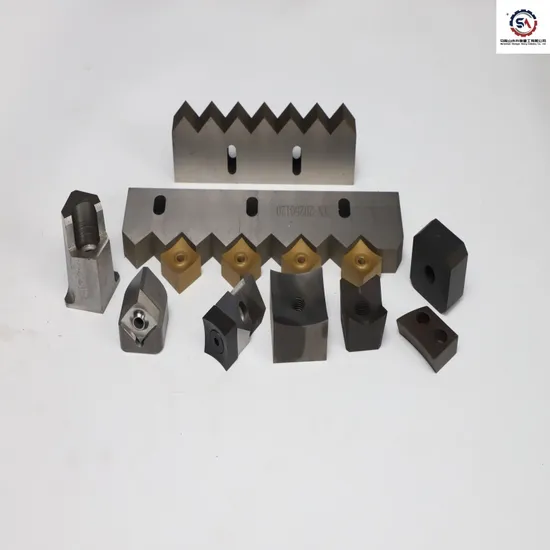
For extreme abrasive duty — fiberglass, mineral-filled compounds, or e-waste — tungsten carbide shredder blades offer significantly longer wear intervals, though at higher unit cost and reduced shock tolerance.
Precision CNC Ground Shredder Cutters: The Geometry That Counts
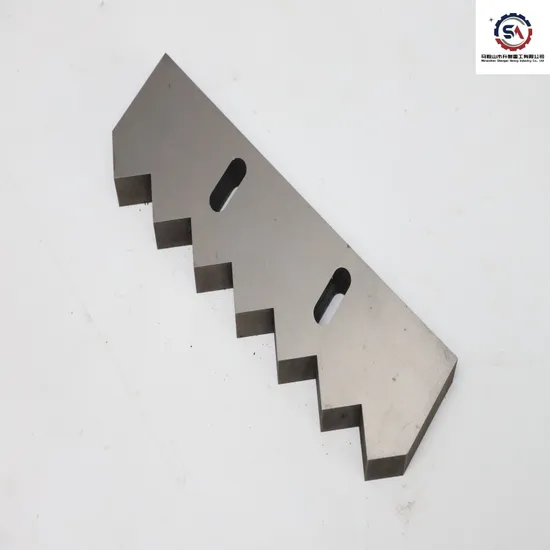
Hardness alone does not cut plastic efficiently — edge geometry does. Precision CNC ground shredder cutters are produced on multi-axis grinders that hold rake angle, relief angle, and cutting-edge radius within tight tolerances, blade after blade. In batch production, this repeatability is what allows operators to rotate or replace individual knives without re-shimming the whole rotor.
- Rake angle control: typically 0–15° depending on feed material; consistent angle equals consistent pull-in and throughput.
- Edge radius: a controlled micro-radius resists chipping on brittle plastics while maintaining shear efficiency.
- Side-face parallelism: critical for stacked rotor configurations and spacer fit.
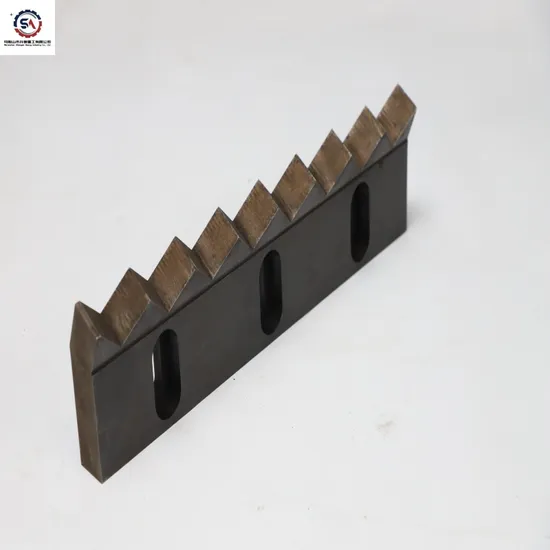
- Mounting-hole position tolerance: ensures true OEM drop-in fit without rotor modification.
Every batch should ship with dimensional reports and hardness test certificates so maintenance teams can verify conformity on receipt.
Batch Customization Workflow: From Drawing to Delivered Lot
A disciplined batch program follows a fixed sequence. Skipping steps is where inconsistency creeps in.
Step 1 — Specification Review
Submit OEM part numbers, 2D drawings, or physical samples. The manufacturer confirms material grade, target hardness range, edge geometry, and quantity per lot.
Step 2 — Material Certification and Cutting
Steel arrives with mill certificates. Blanks are cut and pre-machined, with traceability tags linking each blank to its heat number.
Step 3 — Controlled Heat Treatment
Vacuum or atmosphere-controlled hardening and multiple tempers bring the lot into the HRC 58-62 window. Hardness is sampled across the batch — not just on one coupon — and recorded.
Step 4 — CNC Grinding and Finishing
Edges are ground to final geometry, then inspected for parallelism, angle, and surface finish. Optional coatings (TiN, TiAlN) can be applied for additional lubricity.
Step 5 — Final Inspection and Packing
Dimensional and hardness reports accompany the shipment, with blades packed in matched sets for straightforward rotor installation.
Technical Specifications
| Parameter | Standard Range | Notes |
|---|---|---|
| Material Grade | AISI D2 / JIS SKD11 | Alternative: tungsten carbide, DC53 |
| Hardness | HRC 58–62 | Lot-verified, narrow sub-range on request |
| Edge Geometry | Custom rake & relief angles | CNC ground to drawing |
| Surface Finish | Ra 0.4–0.8 µm (ground faces) | Coating optional |
| Tolerance (critical dims) | ±0.02 mm | Per drawing requirements |
| Typical Batch Size | 10–1,000+ pcs | Matched sets available |
| Lead Time | 15–30 days | Depends on quantity and coating |
Specifying OEM Replacement Blades Correctly
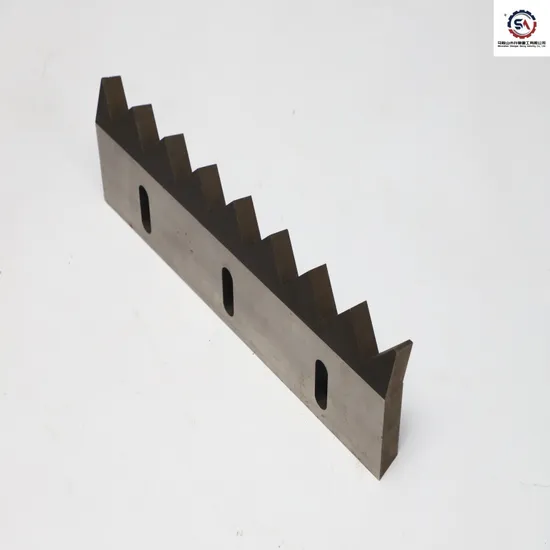
To get true drop-in fit, supply the OEM part number, machine make/model, rotor diameter, and blade count per rotor. Include a sample blade if available — reverse-engineering from a worn part is reliable only when the wear pattern is documented. For custom industrial cutting knives for plastic recycling, also state the feed material (rigid PVC, HDPE lumps, PET bales, film) and any contamination profile. This lets the manufacturer tune hardness and edge radius to your actual duty cycle rather than a generic spec.
Review our full range of industrial shredder blades to compare configurations across single-shaft, dual-shaft, and granulator platforms.
Frequently Asked Questions
What hardness should D2 or SKD11 shredder blades be?
HRC 58–62 is the standard range. Choose the lower end for impact resistance with mixed or metal-contaminated feed, and the upper end for maximum abrasion resistance with filled or glass-reinforced plastics.
Can you manufacture blades to match my existing OEM rotor?
Yes. Provide the OEM part number, drawings, or a sample, and blades are CNC ground to match mounting holes, thickness, and edge geometry for drop-in installation without rotor modification.
What is the minimum order quantity for batch customization?
Typical batch programs start around 10 pieces per profile, with matched sets and larger lots (up to 1,000+ pieces) offering better per-unit economics and tighter lot consistency.
Request a Batch Customization Quote
Send your drawings, OEM part numbers, material specification, and estimated annual volume. Our engineering team will return a feasibility assessment, recommended steel grade and hardness window, sample timeline, and batch pricing — usually within one business day.