
How to Choose the Right Slitting Blades for Your Machine
How to Choose the Right Slitting Blades for Your Machine
1. Table of Contents
- Introduction
- Key Factors in Slitting Blade Selection
- ShengAo Slitting Blade Solutions: Engineered for Performance
- Industry-Specific Applications & Solutions
- Proper Installation, Maintenance & Optimization
- Total Cost of Ownership & ROI Analysis
- Market Comparison & Competitive Advantages
- Frequently Asked Questions (FAQ)
- Conclusion & Next Steps
Introduction
In the high-speed world of converting and material processing, the efficiency of your entire operation hinges on one critical component: the slitting blades. These precision tools are responsible for transforming master rolls of paper, plastic, metal, and composite materials into perfectly sized strips, directly impacting product quality, production speed, and your bottom line. Choosing the wrong blade can lead to a cascade of problems—excessive dust, poor edge quality, frequent blade changes, and costly material waste. This comprehensive guide will walk you through the essential factors in selecting the optimal ShengAo slitting blades for your specific machine and application. By understanding material science, blade geometry, and proper maintenance, you can unlock significant gains in productivity, ensure consistently clean cuts, and dramatically reduce operational costs. Whether you're processing thin films or tough composites, the right blade is not just a tool; it's a strategic investment in your manufacturing efficiency.
2. Key Factors in Slitting Blade Selection
Selecting the perfect slitting blade is a multi-variable equation. It requires a deep understanding of what you're cutting, how you're cutting it, and the machine performing the cut. Ignoring any single factor can compromise performance.
2.1. Understanding Material Type: Paper, Film, Metal, Composites
The primary driver of blade selection is the material itself. Each family presents unique challenges:
- Paper & Cardboard: Requires sharp, clean-cutting edges to prevent fiber tear and dusting. Coated papers demand harder materials to resist abrasion.
- Plastic Films (PP, PE, PET, BOPP): Needs exceptionally sharp edges to achieve a "score" or "shear" cut without stretching or deforming the film. Anti-stick coatings may be necessary.
- Metal Foils & Thin Metals: Demands extreme hardness and wear resistance. Tungsten carbide is often the go-to material to maintain a sharp edge against abrasive metal oxides.
- Composite & Laminated Materials: Often the most challenging, as they combine layers with different properties (e.g., foil + plastic + adhesive). A blade must be hard enough to cut the abrasive layer yet tough enough not to chip.
- Textiles & Nonwovens: Benefits from specialized edge geometries like micro-serration to grip slippery fibers and prevent shifting during the cut.
- Specialized Streams: E-waste shredder blades and metal scrap shredder blades are designed for size reduction, but their principles of wear resistance translate to slitting abrasive circuit boards or metalized films.
2.2. Blade Material Science: From HSS to Tungsten Carbide
The core of a blade's performance lies in its metallurgy. ShengAo offers a complete spectrum of advanced materials:
- Tool Steels (D2, A8, etc.): Excellent all-rounders offering a good balance of toughness and wear resistance. D2 shredder blades, for instance, are known for high carbon and chromium content, providing good wear resistance for many general applications.
- High-Speed Steel (HSS - M2, M35): Retains hardness at high temperatures generated during high-speed slitting. Ideal for continuous, high-volume paper and plastic film operations.
- SKD11 blade / Alloy Steel: A high-carbon, high-chromium cold work steel known for excellent hardness (HRC 58-62) and dimensional stability after heat treatment. Superior for long runs on abrasive materials.
- Cr12MoV blade: Another premium cold work die steel with high hardenability and wear resistance, often used as a cost-effective alternative to more expensive grades for demanding slitting tasks.
- Tungsten Carbide: The pinnacle of wear resistance. Ideal for slitting abrasive materials like coated papers, carbon fiber, fiberglass, and metals. ShengAo tungsten carbide circular blades can offer up to 50x the life of steel blades in abrasive applications.
- Carbide-Tipped & Inlaid Blades: Provide the wear resistance of carbide on the cutting edge with the toughness and lower cost of a steel body. A versatile and popular solution.
The choice depends on balancing wear resistance (hardness), toughness (resistance to chipping), and cost for your specific material.
2.3. Blade Geometry & Edge Configuration
The shape of the blade and its edge determine the cutting mechanism and finish.
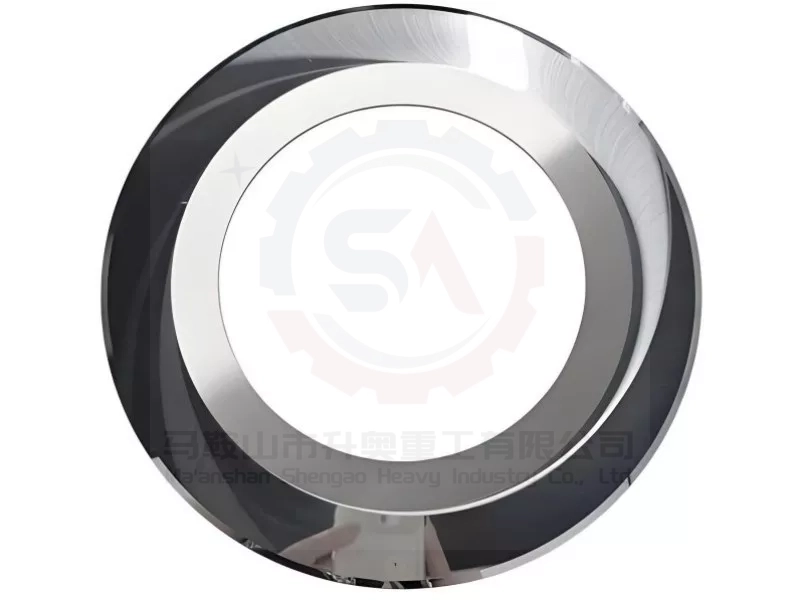
- Razor / Score Cutting: Uses a single sharp blade pressing against a hardened anvil roll. Requires an ultra-sharp, often single-bevel edge.
- Shear / Tangential Cutting: Employs two overlapping blades (top and bottom) that shear the material like scissors. Blades have specific clearance angles and often feature a double-bevel design.
- Crush / Downward Pressure Cutting: Less common, uses high pressure. Not recommended for precision work as it degrades edges quickly.
- Edge Types:
- Plain Edge: Standard sharp edge for clean cuts on uniform materials.
- Serrated Edge (Micro/Macro): Teeth grip the material, preventing slippage. Essential for textiles, nonwovens, and slippery films. Shengao serrated cutting blades are precision-engineered for this purpose.
- Coated Edges (TiN, TiCN, CrN): Applied via PVD coating to reduce friction, prevent material buildup (anti-stick), and extend blade life.
2.4. Machine Compatibility & Technical Specifications
A perfect blade for the material is useless if it doesn't fit your machine. Critical specifications include:
- Blade Diameter (OD) and Bore Size (ID): Must match the machine's arbors and spacers exactly.
- Thickness & Width: Affects the slit width accuracy and the stiffness of the blade.
- Hardness (HRC): Must be appropriate for the material. Softer materials can use harder blades for longer life, but brittle materials may require a slightly tougher (less hard) blade to avoid chipping.
- Tolerance: Precision-ground blades with tight tolerances (e.g., ±0.005mm) ensure consistent performance and easy setup. This is a hallmark of ShengAo precision industrial circular blades.
2.5. ShengAo Slitting Blades in Action - Video Showcase

3. ShengAo Slitting Blade Solutions: Engineered for Performance
ShengAo approaches slitting blade manufacturing as a precision science, combining advanced materials, rigorous engineering, and stringent quality control to deliver solutions that outperform.
3.1. Premium Material Portfolio
ShengAo doesn't just sell blades; we provide material solutions. Our portfolio is carefully curated:
- HSS Series: For high-speed, high-temperature environments.
- Tool Steel Series (D2, Cr12MoV): For balanced performance in general converting.
- Alloy Steel Series (SKD11): For superior wear resistance in abrasive applications.
- Tungsten Carbide Series: Solid and tipped blades for the ultimate in longevity when processing highly abrasive or metallic materials.
We help you select not just a blade, but the optimal material grade within each series based on your specific wear patterns and performance requirements.
3.2. Precision Manufacturing & Quality Assurance
Every ShengAo blade undergoes a controlled manufacturing journey:
- Material Sourcing & Verification: Raw materials are sourced from certified mills and verified for composition.
- CNC Precision Machining: Blanks are cut and shaped with CNC machinery for dimensional accuracy.
- Proprietary Heat Treatment: The critical step that determines final hardness, toughness, and stress relief. Our controlled atmosphere furnaces ensure consistency.
- Precision Grinding: Cutting edges and critical surfaces are ground on CNC grinders to achieve tolerances within ±0.005mm and Ra 0.2µm surface finishes.
- 100% Inspection: Hardness testing, dimensional checks, and visual inspection guarantee every blade meets our strict standards before shipment.
This process ensures our hardened shredder blade philosophy applies equally to our slitting blades: maximum durability through superior processing.
3.3. Comprehensive Product Range
ShengAo provides a vast array of standard and custom shredder blades OEM solutions, a flexibility that extends to our slitting blades:
| Product Type | Primary Material | Typical Hardness (HRC) | Best For |
|---|---|---|---|
| Standard Circular Slitter Knives | HSS, Tool Steel | 58-62 | Paper, cardboard, general plastics |
| Precision Shear Cut Blades | SKD11, D2 | 60-63 | Tangential slitting of films, foils, laminates |
| Tungsten Carbide Slitter Knives | YG6, YG8 Carbide | HRA 89-92 | Abrasive materials, metals, composites, carbon fiber |
| Serrated Edge Blades | 9CrSi, HSS | 55-60 | Nonwovens, textiles, slippery films, rubber |
| Razor / Score Cut Blades | Tool Steel, Carbide-Tipped | 58-62 (Edge >90) | BOPP film, thin papers, precision slitting |
Beyond standards, our OEM shredder blades capability means we can reverse-engineer, design, and manufacture any custom slitting blade to your exact drawings and specifications.
4. Industry-Specific Applications & Solutions
The right blade strategy varies dramatically by industry. Here’s how ShengAo tailors its solutions.
4.1. Paper Converting & Packaging
Challenge: Achieving dust-free, clean cuts on everything from newsprint to heavy, coated boardstock. Solution: Sharp, hardened blades (HSS or SKD11) with appropriate edge geometry. For coated papers, carbide-tipped blades dramatically reduce edge wear and changeover frequency. ShengAo blades for the papermaking & packaging industries are engineered for this precise need.
4.2. Plastics & Flexible Films
Challenge: Preventing edge stretch, "angel hair," and poor seals on slippery films like PE, PP, and PET. Solution: Ultra-sharp, often coated (non-stick) blades for score cutting. Shear cut blades must have perfect edge alignment and sharpness. This is where shredder blades for plastic recycling principles of sharpness and wear resistance intersect with precision slitting.
4.3. Metal Foil & Composite Materials
Challenge: Extreme abrasiveness quickly dulls steel blades, leading to burrs and poor edge quality. Solution: Tungsten carbide is almost always required. ShengAo solid carbide or carbide-tipped slitters maintain a sharp edge thousands of times longer than steel, ensuring consistent, burr-free slits on aluminum foil, copper tapes, and metalized laminates.
4.4. Specialized Materials (E-Waste, Textiles, Battery Electrodes)
Challenge: Unique material properties demand specialized solutions.
- Technical Textiles & Nonwovens: Micro-serrated ShengAo serrated cutting blades prevent material pull and ensure straight cuts.
- Battery Electrode Slitting (Anode/Cathode): Requires ultra-clean, dust-free cuts to prevent short circuits. High-precision, coated carbide blades are essential.
- Challenging Recycling Streams: While not slitting, the development of long life shredder blades for tough feeds informs our approach to creating durable blades for abrasive composite slitting.
5. Proper Installation, Maintenance & Optimization
Even the best blade will underperform if poorly installed or maintained.
5.1. Installation Best Practices
- Cleanliness: Ensure arbors, spacers, and blade seats are spotless and free of nicks.
- Handling: Always wear gloves to prevent corrosion from skin oils. Handle blades by the bore, not the edge.
- Mounting: Follow manufacturer torque specifications for clamping nuts. Over-tightening can distort blades and arbors.
- Alignment: For shear cutting, precise alignment of top and bottom blades is critical. Use setup gauges.
5.2. Routine Maintenance & Inspection Schedule
- Daily: Visually inspect edges for nicks, chips, or buildup. Clean blades with appropriate solvents.
- Weekly: Check for runout and blade wobble. Verify arbor and bearing condition.
- Performance-Based: Monitor cut quality. An increase in dust, burrs, or edge fray is the first sign a blade needs attention (cleaning, re-sharpening, or replacement).
5.3. Common Problems & Troubleshooting
| Problem | Possible Cause | Solution |
|---|---|---|
| Excessive Dust / Burrs | Dull blade, wrong blade material, incorrect blade alignment | Sharpen/replace blade, upgrade to harder material (e.g., carbide), realign blades |
| Poor Edge Quality (Tearing) | Blade not sharp enough, excessive blade pressure, incorrect edge type (e.g., plain vs. serrated) | Sharpen blade, adjust pressure, switch to a serrated blade for grippy materials |
| Material "Walks" or Drifts | Worn or incorrect serrations, misaligned guides | Replace with properly serrated blade, realign web guides |
| Short Blade Life | Blade material too soft for application, abrasive material, improper heat treatment | Upgrade to a harder grade (SKD11, Carbide), consult ShengAo for material recommendation |
5.4. Blade Sharpening & Reconditioning Services
Sharpening is more cost-effective than replacement. ShengAo offers professional reconditioning services that restore the original edge geometry, hardness, and performance. We recommend reconditioning at the first sign of quality degradation to protect your material and maximize total blade life.
6. Total Cost of Ownership & ROI Analysis
The cheapest blade is often the most expensive in the long run.
6.1. Initial Cost vs. Long-Term Value
A premium blade from ShengAo may have a higher initial price but delivers value through:
- Longer Life: Fewer changeovers mean less downtime and lower blade cost per meter slit.
- Consistent Quality: Reduced waste from poor cuts and fewer customer rejections.
- Higher Machine Utilization: Less time spent on blade setup and adjustment.
6.2. Measuring Productivity & Waste Reduction
Track key metrics before and after switching to optimized blades:
- Meters/Roll per blade change
- Percentage of waste/scrap due to edge defects
- Machine downtime for blade-related maintenance
- Energy consumption (a sharp blade often requires less drive power)
6.3. Case Study: Cost Savings with ShengAo Slitting Blades
Scenario: A packaging company slitting coated cardboard.
- Old Solution: Standard tool steel blades lasting 3 shifts before quality declined. Generated significant dust, requiring frequent line cleaning.
- ShengAo Solution: Upgraded to SKD-11 shredder blades (similar premium steel used in slitters) with a specialized edge prep.
- Result: Blade life increased to 12 shifts. Dust reduced by 70%. Calculated ROI was under 2 months due to reduced downtime, blade costs, and material waste.
7. Market Comparison & Competitive Advantages
7.1. Global Slitting Blade Market Trends
The market is driven by demand for higher precision, longer life, and solutions for new advanced materials like composites and battery foils. There is a clear shift towards application-engineered solutions rather than generic blades.
7.2. ShengAo's Competitive Edge
| Aspect | ShengAo | Generic Suppliers | Western Premium Brands |
|---|---|---|---|
| Material Expertise | Full portfolio from HSS to Solid Carbide, in-house heat treatment | Limited grades, often outsourced heat treatment | Strong, but often at premium pricing |
| Customization & OEM | Full custom shredder blades and slitting blade service, rapid prototyping | Standard sizes only | Available but with long lead times and high MOQs |
| Precision & Tolerance | CNC grinding, ±0.005mm standard, 100% inspection | Loose tolerances, inconsistent quality | High precision |
| Technical Support | Direct engineering support, wear analysis, application consulting | Minimal or none | Good, but often through distributors |
| Value Proposition | Premium performance at competitive direct-factory pricing | Low price, high long-term cost | High performance, high price |
8. Frequently Asked Questions (FAQ)
How often should I sharpen or replace my slitting blades?
There's no fixed interval. Sharpen blades at the first sign of quality decline (increased dust, burrs, poor edge). Replacement is needed when the blade can no longer be ground back to its original profile or if it's damaged. A premium blade like those from ShengAo may be re-sharpened 5-10 times before replacement.
What's the difference between shear cut and score cut blades?
Shear cutting uses two overlapping blades (like scissors) and is excellent for a wide range of materials, providing a clean, controlled cut. Score (or razor) cutting uses one blade against an anvil roll, ideal for very thin, delicate, or pressure-sensitive materials where a shear's pinch might cause distortion.
Can I use the same blade for different materials?
It's not recommended. Different materials have different abrasiveness and cutting requirements. Using a blade optimized for paper on plastic film will not give a clean finish, and using a film blade on abrasive material will ruin it quickly. For multi-material lines, consult ShengAo for a versatile compromise or plan for blade changes.
Why are tungsten carbide blades so much more expensive? Are they worth it?
Carbide is more expensive due to the raw material cost and the complex sintering manufacturing process. They are absolutely worth it for abrasive applications (coated papers, metals, composites). Their lifespan can be 20-50 times that of a steel blade, eliminating frequent changeovers and ensuring consistent cut quality for vastly longer periods, leading to a lower total cost per cut.
How do I know if I need serrated blades?
If your material slips, stretches, or doesn't cut cleanly with a plain edge blade—common with nonwovens, textiles, rubber, and some slippery films—you need serrated blades. The teeth grip the material, ensuring a clean, controlled shear. ShengAo's serrated blade guide can help you choose the right tooth pattern.
My supplier offers "hardened" blades. What does that mean?
Hardening is a heat treatment process that increases the blade's hardness (measured in HRC). All performance blades are hardened. The key questions are: to what hardness level, and with what consistency? ShengAo's controlled process ensures uniform hardness throughout the blade, not just on the surface, which is critical for long-term hardened blade performance.
9. Conclusion & Next Steps
Selecting the right slitting blades is a critical decision that directly impacts your production efficiency, product quality, and profitability. It's a decision that goes beyond simply matching a diameter and bore. By carefully considering your material type, choosing the appropriate blade material (from HSS to Tungsten Carbide), selecting the correct geometry, and adhering to proper installation and maintenance protocols, you can transform a cost center into a source of competitive advantage.
ShengAo stands ready to be your partner in this process. With our extensive material portfolio, precision manufacturing capabilities, deep application knowledge, and full custom shredder blades OEM support, we provide more than just a blade—we provide a engineered cutting solution designed to maximize your machine's uptime and output.
Ready to optimize your slitting operation? Contact the ShengAo engineering team today for a personalized consultation.
Brand: ShengAo
Contact: Engineer Jack
Email: jack@shenaozg.com
Mobile: +86 136 9673 1068
WhatsApp: +86 152 1234 9604
Address: Bowang town Songhua River road, Bowang District, Ma'anshan City, China